1. Why Does the ‘Noisy Neighbor’ Problem Inevitably Occur?
The core of Kubernetes operations is Resource Sharing. But sharing inevitably leads to Contention.
- The causal chain: 1. Multiple pods are placed on a single physical node (Bin Packing) to reduce costs.
- A specific pod (A) experiences a traffic surge or an infinite loop in its logic.
- Pod (A) occupies the node’s shared resources (CPU, Memory, etc.) to their limits.
- Other pods (B) on the same node suffer from resource starvation, leading to performance degradation or outages.
To break this chain of cause (resource sharing) → process (a runaway pod) → effect (damage to other services), Kubernetes provides two primary control mechanisms: QoS (Quality of Service) and PriorityClass.
2. Impact by Resource Type
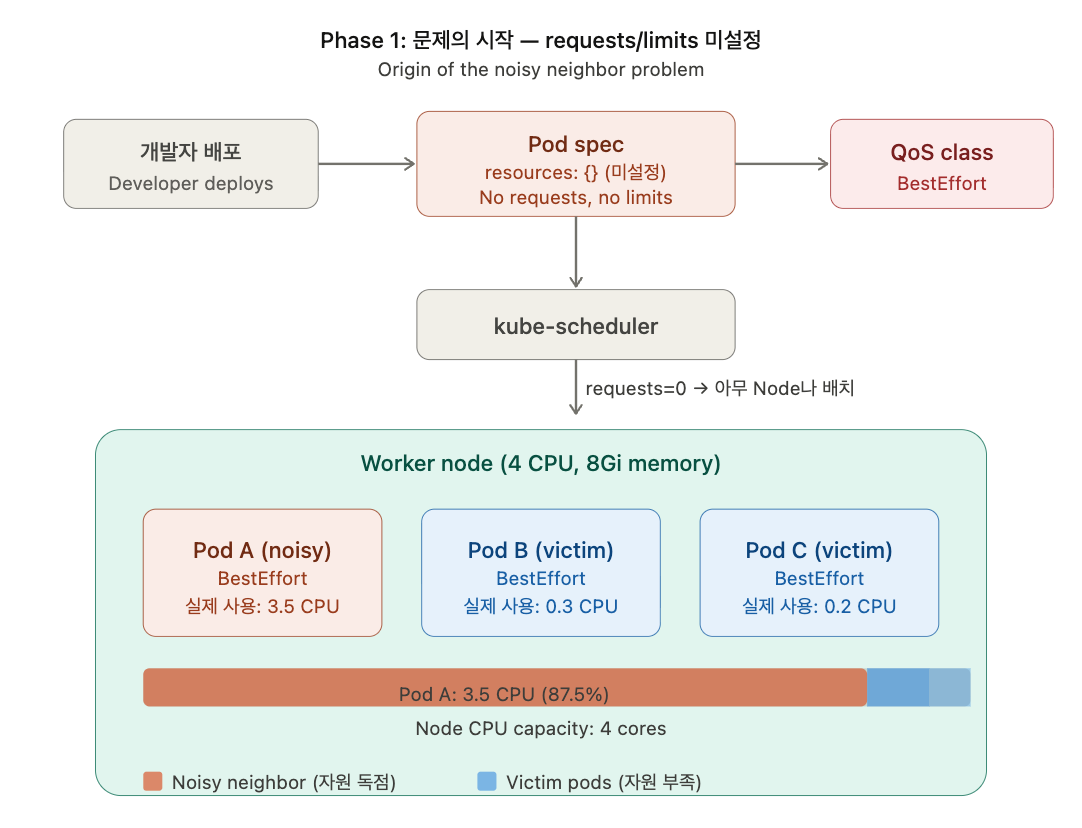
The impact of a ‘noisy neighbor’ differs depending on the type of resource involved. Understanding this is essential for formulating the right countermeasures.
| Resource Type | Characteristic | Causal Chain When Resource Is Scarce | Outcome |
|---|---|---|---|
| CPU | Compressible | A specific pod monopolizes shared CPU cycles → insufficient CPU time allocated to other pods | Throttling: Degraded computation speed and increased response latency |
| Memory | Incompressible | Physical memory exhausted → kernel forcibly terminates lower-priority processes to keep the system alive | OOM Kill: Abnormal pod termination and restart (Liveness Probe failure) |
| Disk I/O | Shared Bandwidth | Massive log/file writes occupy I/O channels → other pods wait on kernel-level I/O | I/O Wait: System-wide freezing and application timeouts |
| Network | Shared Bandwidth | A specific pod saturates NIC bandwidth with large data transfers (backups, deployments, etc.) → packet transmission queues up | Latency & Packet Loss: Increased network response latency and retransmissions due to data loss |
3. QoS Classes (Resource Usage Patterns)
Kubernetes automatically assigns a class to a pod based on its declared requests and limits. This class determines “who gets evicted first” when node resources run low.
① Guaranteed (Top Tier: Absolute Assurance)
- Configuration:
requests == limits(when both CPU and Memory are set) - Causal chain: The scheduler reserves those resources exclusively → no matter how noisy the neighboring pods are, these resources cannot be taken away.
- Use case: Core services that must never go down, such as databases and payment engines.
② Burstable (Middle Tier: Flexible Efficiency)
- Configuration:
requests < limits(or only one of the two is set) - Causal chain: Consumes less under normal conditions but scales up when needed → becomes the first eviction candidate when node resources are scarce, in order to protect
Guaranteedpods. - Use case: Most microservices, including general API servers and web frontends.
③ BestEffort (Bottom Tier: Using Leftover Resources)
- Configuration: Neither
requestsnorlimitsare set. - Causal chain: No resource reservation at all → evicted immediately under even the slightest node pressure.
- Use case: Low-priority auxiliary workloads such as log collectors and temporary batch jobs.
4. PriorityClass (Ranking by Business Criticality)
If QoS represents the ‘technical tier’ of resource usage, PriorityClass represents the ‘policy-level ranking’ — answering the question: “How critical is this service to our business?”
• The causal chain of Preemption
- A
High-Prioritypod is requested for deployment while the cluster is at full capacity. - The scheduler scans nodes but finds no available space.
- It identifies a currently running pod with
Low-Priorityand forcibly terminates (Preempts) it. - The freed space is used to schedule the high-priority pod.
| Factor | QoS Class | PriorityClass |
|---|---|---|
| Who decides | Automatically assigned by the system based on resource configuration values | Manually assigned by an administrator with a name and score |
| Primary role | Determines who dies first under node pressure | Determines who gets scheduled first when resources are scarce |
| Key metric | Resource allocation efficiency | Service criticality |
5. Practical Architecture Guide for Resolving Noisy Neighbor Issues
Beyond theory — these are strategies for controlling the causal chain in real-world environments.
- Introduce LimitRange (enforce compliance):
When developers omit resource configurations, a flood of
BestEffortpods destabilizes the cluster. By setting aLimitRangeat the namespace level, default values are automatically applied to pods that are missing configurations, preventing ‘rogue pods’ from appearing in the first place. - Set ResourceQuota (namespace-level isolation): Limits the total resources available per namespace to prevent any single team or service from monopolizing the entire cluster. This cuts off the causal chain of “one team’s mistake bringing down the entire company’s services.”
- Taints & Tolerations (physical isolation): Pods with extreme I/O load or high CPU utilization from batch jobs are isolated to designated nodes (Tainted Nodes). This is a strategy of “preventing dangerous neighbors from living in the same apartment building as regular neighbors.”
- Optimize TerminationGracePeriodSeconds:
When a pod is evicted due to
PriorityClass, a proper grace period should be configured so that the terminating pod can safely persist its data before shutting down.
6. Conclusion
Every problem that arises in Kubernetes operations has a clear causal chain.
- The ‘noisy neighbor’ is not a system defect — it is a natural physical phenomenon that occurs in shared resource environments.
- Resolving it is not about reactive monitoring, but about designing a predictable system through rules like QoS and PriorityClass.
The key takeaway I want to emphasize through this report is: “every pod must have at minimum a requests value configured.” This is the very first step that allows the scheduler to pre-calculate the ‘noise level of the neighbors’ and make informed placement decisions.