1. Why Do We Need Controllers?
Kubernetes is a declarative system. Users simply declare the Desired State — “spin up 3 nginx instances” — without specifying how to do it.
The API Server stores this Desired State in etcd, but it does not actually reconcile the Current State to match the Desired State.
💡 Controller = the entity that bridges the gap between Desired State and Current State
Why this architecture? (Causal reasoning)
- Cause: In a distributed system, nodes can die, networks can disconnect, and Pods can vanish at any moment. The current state is inherently unstable.
- Effect: Rather than “issue a command → done,” you need a structure that continuously monitors and automatically restores state whenever a discrepancy arises.
- Analogy: A thermostat. Set it to 25°C and it continuously measures the current temperature, turning heating or cooling on whenever it deviates from the target.
2. Reconciliation Loop (Control Loop)
The core operating principle of a controller:
1. Observe Current State  → "There are currently 2 nginx Pods running"
2. Check Desired State    → "etcd says there should be 3"
3. Calculate Diff         → "We're 1 short"
4. Execute Reconcile      → "Create 1 more Pod"
This loop is called the Reconciliation Loop or Control Loop.
3. Change Detection: Watch and Informer
3-1. Polling vs Event-driven
There are two ways a controller can detect that the current state has changed:
| Method | Description | Drawback |
|---|---|---|
| Polling | Periodically asks the API Server: “what’s the current state?” | Number of controllers × number of resources = API Server overload |
| Watch (Event-driven) | Maintains a long-lived connection to the API Server and receives events pushed on change | Events can be lost if the connection drops |
- Kubernetes’s choice: Watch (Event-driven)
- Reason: No traffic when nothing changes. API Server load scales with change frequency, not resource count — making it stable even in large clusters.
3-2. Informer = List-Watch + Local Cache
Watch alone has two shortcomings:
| Problem | Solution |
|---|---|
| Watch connection drops → events are lost | List-Watch pattern: fetch a full snapshot via List on startup, then switch to Watch. On disconnect, re-sync from List again |
| Multiple controllers querying the API Server simultaneously → increased load | Local cache: the Informer stores data locally; controllers read from the cache instead of the API Server |
💡 Informer = List-Watch + Local Cache, bundled together
3-3. Work Queue (a separate structure outside the Informer)
A separate structure attached outside the Informer. It solves consistency problems in event processing.
Why a Work Queue is needed (example): Three events arrive within one second: “Pod-A deleted” → “Pod-B deleted” → “Pod-A created”
- If Reconcile is called immediately for each event → it reacts to the deletion events by creating extra Pods, only for them to come back via automatic restart → more Pods than intended, causing a consistency problem.
How the Work Queue solves this:
- Instead of the event itself, an object key (e.g.,
default/Pod-A) is enqueued - If the same key already exists in the queue, it is deduplicated
- Reconcile dequeues a key and makes decisions based on the latest local cache state at that point in time
Difference from SQS:
- SQS messages are persistent — they remain in the queue even if the consumer dies.
- The K8s Work Queue is in-memory — if the controller dies, the queue is lost.
- On controller restart, stability is guaranteed by the Informer’s List operation (full re-sync).
3-4. Component Role Summary
| Component | Problem it solves | Core mechanism |
|---|---|---|
| List-Watch (inside Informer) | Event loss when Watch connection drops | Full re-sync via List on reconnect |
| Local Cache (inside Informer) | Query load on the API Server | Read from cache |
| Work Queue (outside Informer) | Event duplication, consistency | Key-based dedup + decisions based on latest cache |
| Reconcile function | Actually closing the gap | Compare desired vs current → execute action |
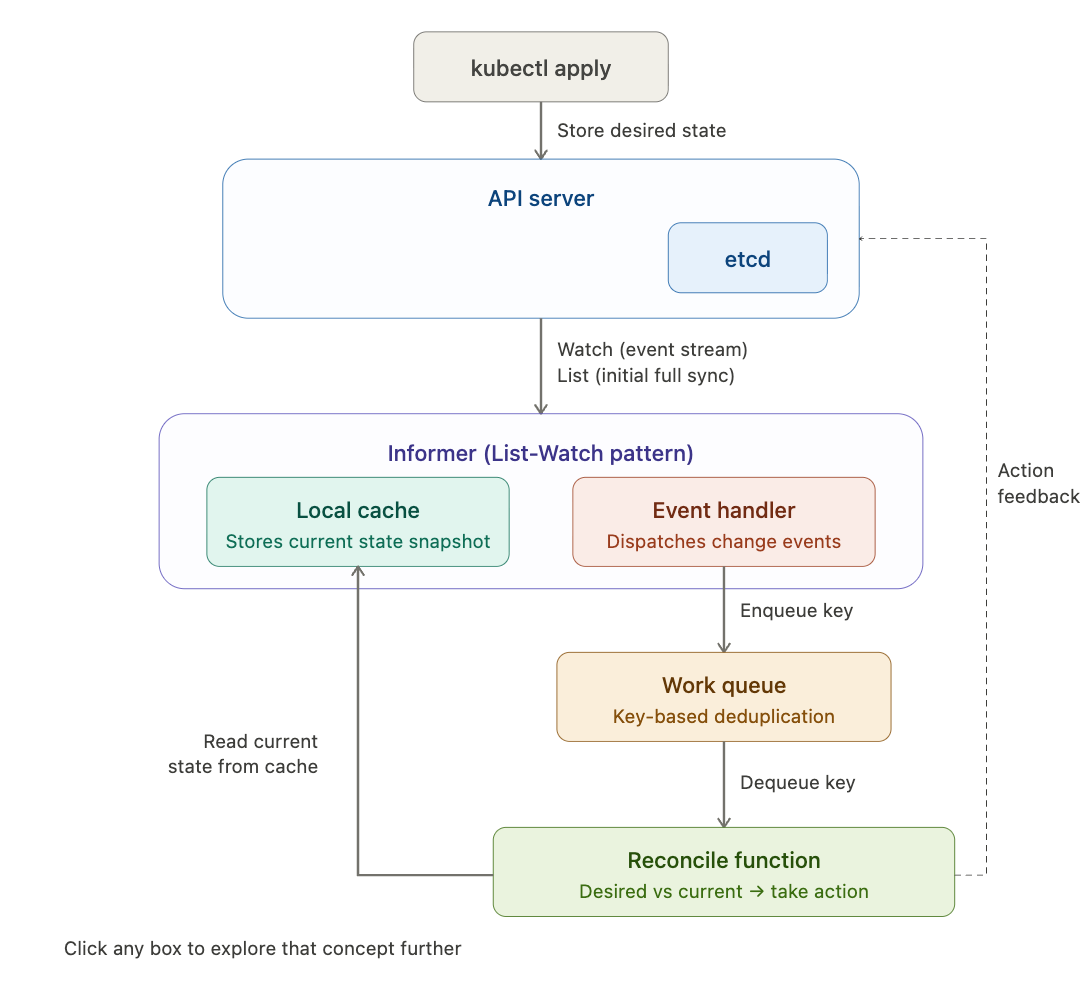
4. End-to-End Flow
kubectl apply (desired state)
        │
        ▼
   API Server ──── etcd (stores desired state)
        │
        │  List (initial full sync)
        │  Watch (subsequent change event stream)
        ▼
    Informer
        │
        ├──→ Local Cache (current state snapshot, read by controllers)
        │
        └──→ Event Handler ──→ Work Queue (key-based dedup)
                                     │
                                     │  dequeue key
                                     ▼
                              Reconcile function
                         (fetch current from cache →
                          compare with desired → execute action)
5. Where Does the Informer Live?
The Informer is not a separate process or Pod. It is a library embedded within each controller’s code (part of client-go).
[Control Plane Node]
  └─ kube-controller-manager (single process)
       ├─ Deployment Controller
       │    └─ Informer (watches Deployment resources)
       ├─ ReplicaSet Controller
       │    └─ Informer (watches ReplicaSet resources)
       ├─ Node Controller
       │    └─ Informer (watches Node resources)
       └─ ...
Multiple controllers run as goroutines inside kube-controller-manager, and each controller has its own dedicated Informer.
6. Separation of Deployment Controller and ReplicaSet Controller
6-1. The Object Chain
Deployment → ReplicaSet → Pod
A Deployment does not create Pods directly — it goes through a ReplicaSet as an intermediary.
6-2. Why the separation? (Causal reasoning)
If the Deployment Controller managed Pods directly: During a rolling update — “is this Pod v1 or v2?”, “how far can I scale down v1?”, “which Pods do I keep on rollback?” — all of this logic would be tangled in one place.
With separation:
| Controller | Role | Characteristics |
|---|---|---|
| Deployment Controller (strategist) | Creates ReplicaSets and adjusts their replicas count | Never touches Pods directly. Understands rolling/rollback strategy |
| ReplicaSet Controller (executor) | Creates/deletes Pods to match the replicas count it was given | Knows nothing about rolling updates. Just “keep 3 running” → keeps 3 |
💡 This is Kubernetes’s Single Responsibility Principle — the hierarchical controller pattern