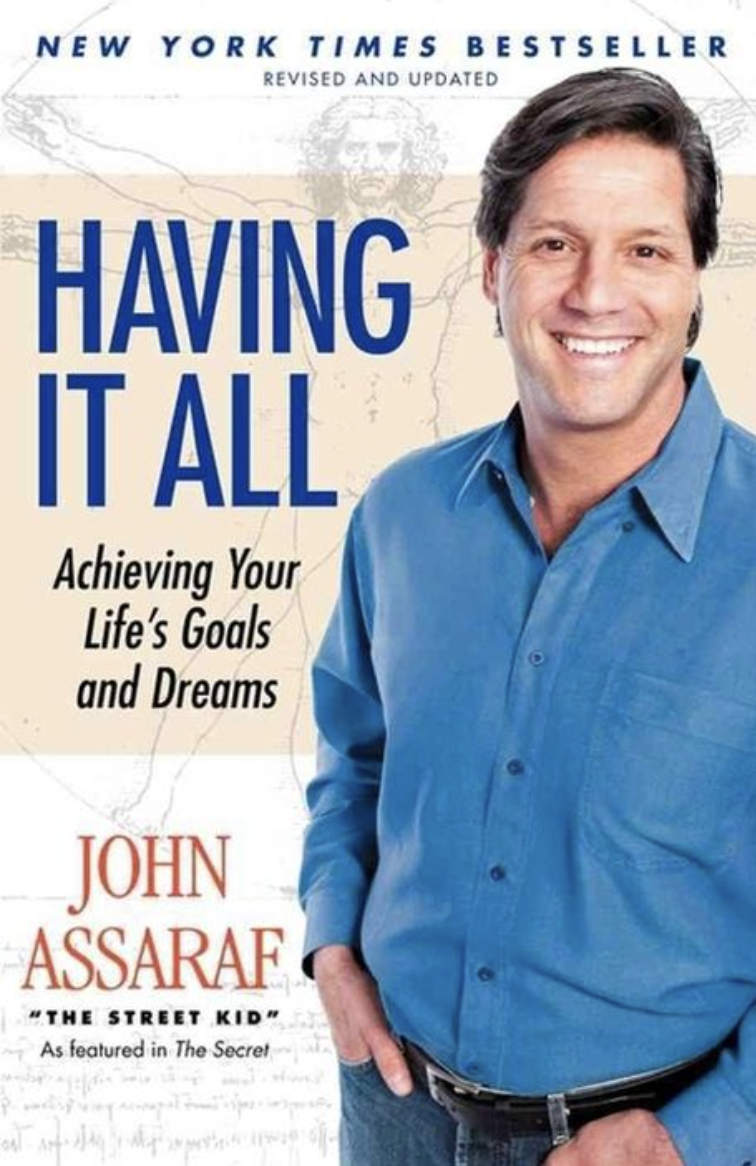
I read John Assaraf’s Having It All.
A self-help book by the author who appeared in “The Secret.” The Law of Attraction. Positive thoughts create a positive reality. Honestly, at first I thought it was that kind of book. The universe is on your side, wish for something and it will come true. That sort of sweet talk.
But as I read on, it wasn’t simply a story of “believe and it will happen.”
Energy Is Everything
The most fundamental premise of this book is this: everything is energy. Our thoughts, emotions, relationships, money, health. John Assaraf calls this “The Great Law,” and says the other seven natural laws all derive from it.
The Law of Vibration, the Law of Relativity, the Law of Cause and Effect, the Law of Polarity, the Law of Rhythm, the Law of Gender, and the Law of Perpetual Transmutation.
The names sound grand, but the core of what I understood was simpler than expected.
Energy itself is neither positive nor negative. It is we ourselves who judge and define it. Without comparison, no definition can be made. Where there is light, there is darkness; where there is happiness, there is unhappiness. And it all moves in cycles. Happiness has an end, and so does unhappiness. If we define any one state as permanent, we become trapped in it.
In the end, all these laws were saying one thing: how we see ourselves as we move through life, and how we should adjust our thinking.
But Is This Science?
After closing the book, one question remained. Is this really a “law”? Does the universe truly respond to my thoughts?
I looked into quantum mechanics. It was true that at the smallest units of matter, everything reduces to energy. It was also physically accurate that everything vibrates at the atomic level.
But the claim that “the vibration of thought attracts the same frequency in the universe” was a different matter. Quantum effects occur at the subatomic particle level — they cannot be directly applied to macroscopic phenomena like human thoughts or emotions. Physicists have criticized this kind of connection as “quantum mysticism.”
So I changed direction. Instead of quantum mechanics, I turned to neuroscience.
And there, I found something interesting.
What the Brain Does
Our brains have a neural network called the Reticular Activating System (RAS). Located in the brainstem, this system acts as a filter, sorting out what matters from the billions of bits of sensory information flooding in every moment. When you decide to buy a new car and suddenly start noticing that car everywhere on the street — that’s the RAS at work.
The latest neuroscience explains this more precisely. What actually recognizes patterns related to goals is a more complex system called the Salience Network. It detects emotionally significant information, switches between internal focus and external action, and prioritizes based on personal meaning.
And then there’s neuroplasticity. The fact that repetitive thoughts and actions actually change the physical structure of the brain. New neural pathways form, replacing old, limiting ones. This is established scientific fact.
When you vividly imagine a goal, dopamine is released, driving motivation and persistence. Research has shown that simply imagining moving your hand activates the motor regions of the brain.
In other words, much of what the Law of Attraction describes as “the universe sending it to you” is actually my brain’s attention filter being reset and my neural pathways being rearranged, changing my behavior. Opportunities didn’t suddenly appear — I simply became able to perceive opportunities that were already there.
Debating a Physicist, a Psychologist, and a Philosopher
At this point, I wanted to stress-test these ideas. So I held a debate with three hypothetical experts: a physicist, a psychologist, and a philosopher. I took the pro side, and the three attacked from their respective perspectives.
The physicist asked: “What’s valid here is goal-setting, not attraction. Why treat the two as the same thing?”
The psychologist pointed out: “This is survivorship bias — you’re only looking at people who succeeded. What about those who wanted just as badly but failed?”
The philosopher posed a foundational question: “What exactly does ‘valid’ mean here? Is it a physical law of the universe, a psychological tool, or a philosophy of life?”
I conceded. It is not a physical law of the universe. But as a psychological tool and philosophy of life, it is valid.
Then the truly sharp question came.
Why Do Humans Need the “Universe”?
The psychologist brought up the dopamine system. “The feeling of Having — the prescription to feel as if you already have it — works against the dopamine system. Dopamine fires most strongly in response to longing for something not yet possessed. Tricking the brain into believing it already has something could actually reduce motivation.”
This was a fair point. But I countered like this.
If we only follow the dopamine system, that’s nothing more than surrendering to instinct. Living at the mercy of impulse, with no restraint, no planning, no control. The feeling of Having that the Law of Attraction describes isn’t about following dopamine’s urges — it’s a ritual for consciously harnessing human desire in order to practice restraint and achieve what you want.
And I also spoke about the vague entity called the “universe.”
Humans are inherently fragile. If even one basic need goes unmet, deep thinking becomes difficult. We know our own limits all too well. Without positing something abstract that transcends ourselves — the universe, God, energy — we become trapped in the thought of “this is as far as I can go.”
Imagine someone who says they’re going to terraform Mars. With rational calculation alone, you focus more on why it’s impossible. But the belief that something beyond words is helping make it happen — just that belief alone can change the very act of doing.
The philosopher heard this and said: “That’s a functionalist view of religion. Not whether God exists, but what function believing in God serves for humans. Voltaire said something similar — ‘If God did not exist, it would be necessary to invent him.’”
Fair point. And he asked: “Then isn’t the Law of Attraction not uniquely special? If Christian prayer and Buddhist vows serve the same function, what sets it apart?”
I agreed. The Law of Attraction is not uniquely special. It was simply the catalyst that led me to organize and systematize these thoughts.
What I Revised
Through the debate, I realized something. What I had been defending wasn’t “John Assaraf’s Law of Attraction” — it was “my Law of Attraction.”
I took the scientifically sound parts of the original and revised the problematic parts with my own interpretation.
John Assaraf said “feel as if it has already been achieved.” I supplemented this as: “ignite desire, but also focus on causes and obstacles.”
The original implied “the universe will attract it for you.” I reinterpreted this as “the brain resets and behavior changes.”
In psychology, there is a validated framework called WOOP: Wish (what you want) — Outcome (imagining the best result) — Obstacle (confronting real barriers) — Plan (a concrete plan). My interpretation aligned almost perfectly with this framework.
Igniting desire through the feeling of Having, but not stopping there. Confronting real obstacles, focusing on causes. That is what I took from this book.
Is the Law of Attraction Valid?
My answer is this.
As a physical law of the universe? No. There is no scientific basis for the claim that the vibration of thought attracts the same frequency into reality.
But it can be restated like this.
Humans need purpose. The process of resetting the brain toward that purpose is valid. And a belief system that helps transcend self-imposed limits reinforces that process.
This is less appealing and less concise than claiming the Law of Attraction works. But it is more accurate, and more honest.
We carry a primal urge to constantly explore the essence of things. We don’t even know where that urge comes from. We are programmed this way. This book was one starting point for that exploration, and I walked out from it in my own way.
Reading a book, receiving it critically, and reconstructing it in your own language. Perhaps that itself is a more powerful force than the Law of Attraction.
Debate Summary and Integrated WOOP Theory
1. Starting Point
This is the result of reading John Assaraf’s Having It All and critically examining the Law of Attraction through a panel debate with AI-simulated experts (physicist, psychologist, philosopher).
2. The Original — John Assaraf’s Law of Attraction
The Great Law
“Energy is everything”
The 7 Natural Laws
| Law | Core Idea |
|---|---|
| Law of Vibration | Everything vibrates; thoughts are energy and carry a frequency |
| Law of Relativity | Nothing has meaning until compared to something else |
| Law of Cause and Effect | Every action has a reaction. Thought is cause; reality is effect |
| Law of Polarity | Everything has an opposite (light–dark, happiness–unhappiness) |
| Law of Rhythm | Everything has a natural cycle. Change is constant |
| Law of Gender | Masculine energy (consciousness/thought) and feminine energy (power of manifestation) coexist |
| Law of Perpetual Transmutation | Energy constantly moves into and out of physical form |
Core Prescriptions of the Original
- Define clearly what you want
- Feel as if it has already been achieved (the feeling of Having)
- Repeat visualization, affirmations, and meditation
- The universe will attract it to you
3. The Three Layers Separated Through Debate
Layer 1 — Validity as a Psychological Tool ✅ (unanimous agreement)
Goal-setting → Attention filter reset (RAS/Salience Network) → Neuroplasticity → Behavioral change → Achievement
Neuroscientifically validated mechanisms:
- Reticular Activating System (RAS): Setting a goal filters relevant information, making you more aware of opportunities
- Salience Network: Detects emotionally significant information and sets priorities
- Neuroplasticity: Repetitive thinking physically changes the brain’s structure
- Dopamine system: Goal visualization triggers dopamine release related to anticipated reward, driving motivation
Layer 2 — Validity as a Transcendent Belief System ⚠️ (partial agreement)
Humans are inherently fragile and know their limits well. Without positing an abstract entity that transcends the self — the universe, God, energy — we become trapped in the thought “this is as far as I go.” This transcendent mediator functions as a psychological device for breaking through the limits of thought.
The philosopher’s definition: a functionalist view of religion — not “does God exist” but “what function does believing in God serve for humans” Voltaire’s formulation: “If God did not exist, it would be necessary to invent him”
Note: the Law of Attraction is not uniquely special in this regard. Christian prayer and Buddhist vows serve the same function.
Layer 3 — Validity as a Physical Law of the Universe ❌ (unanimous rejection)
The claim that “the vibration of thought attracts the same frequency into reality”:
- Quantum effects occur at the subatomic particle level and cannot be applied to macroscopic phenomena
- Criticized by physicists as “quantum mysticism”
- No scientific basis; classified as pseudoscience
4. What I Revised from the Original
| Original (John Assaraf) | My Revised Version |
|---|---|
| ”Feel as if it has already been achieved” | Ignite desire, but also focus on causes and obstacles |
| ”The universe attracts it to you” (passive) | The brain resets and behavior changes (active) |
| Having prescription that conflicts with the dopamine system | Conscious restraint and planning that transcends instinct |
| Focus on imagining results | Imagining results (ignition) + confronting obstacles (reality) + concrete plan |
5. Integration with the WOOP Framework
WOOP is a scientifically validated goal-achievement framework developed by Professor Gabriele Oettingen.
WOOP Structure
W — Wish Define clearly what you truly want. → In the Law of Attraction: setting the goal
O — Outcome Vividly imagine the best possible result when it is achieved. → In the Law of Attraction: the feeling of Having. Feeling as if you already possess it. → In neuroscience: igniting motivation through dopamine release; activating motor areas through visualization
O — Obstacle Confront the real obstacles standing in the way of that outcome. → This step is weak in the original Law of Attraction → The key element I supplemented through the debate → In neuroscience: imagining only the outcome can actually reduce motivation; recognizing obstacles alongside the goal raises motivation and achievement rates (Mental Contrasting research)
P — Plan “If obstacle X occurs, I will do Y” — create a concrete action plan. → In the Law of Attraction: the Law of Cause and Effect. Focus on the cause and the result will follow. → Implementation Intentions dramatically increase the probability of action
Integrated Flow Diagram
[Wish] Define clearly what you want
    ↓
[Outcome] Vividly imagine the best result (feeling of Having → dopamine ignition)
    ↓
[Obstacle] Confront real obstacles (Mental Contrasting → motivation reinforcement)
    ↓
[Plan] "If X, then Y" — concrete plan (Implementation Intention → increased action probability)
    ↓
[Repeat] Reinforce neuroplasticity through visualization + affirmations + meditation
    ↓
[Result] Attention filter reset → opportunity recognition → behavioral change → achievement
6. What Happens in the Brain (Mechanism Summary)
Thought (goal-setting)
    ↓
Attention filter reset — RAS/Salience Network prioritizes goal-related information
    ↓
Dopamine release — motivation activation through anticipated reward
    ↓
Neuroplasticity — repeated visualization and thinking rearrange prefrontal neural pathways
    ↓
Behavioral change — new neural pathways guide more effective decision-making and action
    ↓
Opportunity recognition — perceiving opportunities that already existed (not sent by the universe)
    ↓
Achievement
7. Summary of Core Principles
Principle 1: Energy itself is neither positive nor negative It is we ourselves who judge and define it. Without comparison, no definition can be made.
Principle 2: Every state has duality and a cycle Happiness has an end, and so does unhappiness. Defining any one state as permanent traps you in it.
Principle 3: The feeling of Having is an ignition device, not a destination Ignite desire by imagining the outcome, but confronting obstacles and forming a concrete plan must follow.
Principle 4: Humans need a transcendent belief system Whether it’s the universe, God, or energy — it functions as a psychological device for breaking through self-imposed limits. However, it must not become passive waiting.
Principle 5: What does the attracting is not the universe — it’s my brain When a goal is set, the brain’s attention system resets, neural pathways are rearranged, and we begin to recognize opportunities that were already there and change our behavior accordingly.
8. Final One-Line Definition
The Law of Attraction is not a physical law, but a psychological framework for “resetting the brain toward a purpose, leveraging a belief system to transcend self-imposed limits, confronting obstacles, and changing behavior.”